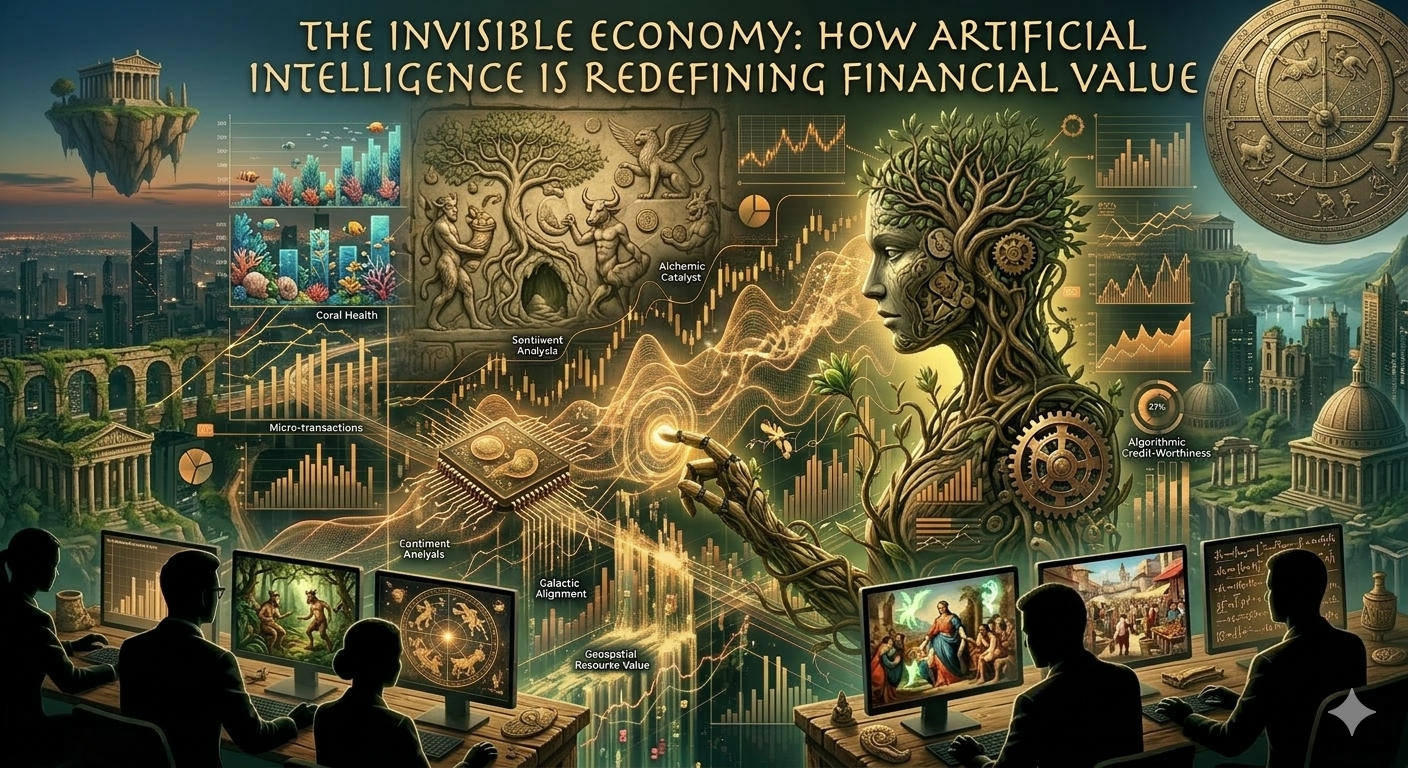
For most of modern economic history, value has been tied to tangible outputs. Factories produced goods, workers generated services, and financial markets assigned value to companies based on measurable performance indicators such as revenue, productivity, and capital assets. However, the emergence of artificial intelligence is quietly transforming how value is created, measured, and distributed in the global economy.
Today, a growing portion of economic activity occurs in systems that are largely invisible to traditional financial metrics. Algorithms trade assets in milliseconds, predictive systems optimize logistics without human intervention, and AI-driven platforms generate insights that shape corporate strategies. These developments are creating what some economists describe as the “invisible economy”—a network of value creation driven by data, automation, and machine intelligence.
While this transformation may not always appear directly in traditional economic statistics, its impact is increasingly visible in how companies operate, how markets behave, and how wealth is generated.
From Physical Assets to Digital Intelligence
For much of the twentieth century, economic value was closely linked to physical assets such as factories, machinery, natural resources, and labor productivity. Even in the early digital era, companies were often valued based on their tangible outputs and financial statements.
Artificial intelligence is shifting this paradigm. Today, companies derive enormous value from intangible assets such as data, algorithms, and digital infrastructure. A well-trained machine learning model can optimize supply chains, forecast demand, and identify profitable market opportunities in ways that traditional business tools cannot.
Technology firms have become some of the most valuable companies in the world not because they own the largest factories, but because they control the most sophisticated digital systems. Their competitive advantage lies in their ability to analyze information and convert it into economic decisions at unprecedented speed.
In this new landscape, data and algorithms are becoming core drivers of financial value.
The Rise of Algorithmic Decision-Making
One of the defining characteristics of the invisible economy is the growing role of automated decision-making. Artificial intelligence systems are now involved in tasks that once required human judgment, from approving loans and pricing insurance policies to allocating investment capital.
In financial markets, algorithms already execute a large share of global trading activity. These systems analyze market signals, economic indicators, and investor sentiment in real time, executing trades in fractions of a second. Human traders still play important roles in strategy and oversight, but much of the operational activity now occurs through automated systems.
Beyond trading, AI is increasingly used in portfolio management, risk assessment, and credit scoring. Machine learning models can evaluate complex patterns in financial behavior, allowing institutions to estimate creditworthiness or market risk more accurately.
As a result, financial value is increasingly shaped by algorithmic processes that operate largely behind the scenes.
Data as a New Form of Capital
In the invisible economy, data functions as a new form of economic capital. Businesses collect vast amounts of information through digital platforms, sensors, financial transactions, and online interactions. When processed through AI systems, this data becomes a powerful resource capable of generating insights and competitive advantages.
Retail companies use customer data to personalize recommendations and optimize pricing strategies. Logistics firms analyze real-time shipping information to streamline global supply chains. Financial institutions process behavioral data to improve fraud detection and risk modeling.
The economic value created by these processes often does not appear directly in traditional balance sheets. Yet the ability to leverage data effectively can determine whether a company dominates its industry or falls behind competitors.
This shift is redefining how investors evaluate companies. Instead of focusing solely on physical assets or short-term earnings, analysts increasingly examine data infrastructure, algorithmic capabilities, and technological innovation.
The Hidden Layers of Financial Activity
Another aspect of the invisible economy is the emergence of financial systems operating beyond traditional market visibility. AI-driven platforms manage automated investment strategies, optimize insurance risk pools, and allocate capital across complex digital ecosystems.
In decentralized finance (DeFi) and blockchain-based systems, algorithms known as smart contracts automatically execute financial transactions without intermediaries. These systems can provide loans, insurance coverage, or asset trading through code rather than traditional institutions.
Although these systems may still represent a relatively small portion of the global economy, their growth demonstrates how technology can create entirely new layers of financial activity that operate independently from conventional frameworks.
In many cases, the economic value generated by these systems is not easily captured by existing regulatory or statistical models.
Economic Productivity Without Visible Labor
Artificial intelligence also challenges traditional ideas about productivity. Historically, economic growth has been associated with increases in labor output or capital investment. However, AI allows companies to generate value through automated systems that require minimal human intervention.
For example, an AI-driven logistics platform may continuously optimize delivery routes, reducing costs and improving efficiency without expanding its workforce. Similarly, automated customer service systems can handle millions of inquiries simultaneously without human staff.
This form of productivity—generated by algorithms rather than workers—can significantly increase economic efficiency. Yet it also raises important questions about employment, income distribution, and how societies measure economic contribution.
Traditional indicators such as employment levels may no longer fully reflect the true drivers of economic growth.
Challenges in Measuring the Invisible Economy
The rise of AI-driven economic activity presents challenges for economists and policymakers. Many traditional economic metrics were designed for industrial economies centered on physical production and labor markets.
In contrast, the invisible economy often generates value through intangible digital processes that are difficult to quantify. Data assets, algorithmic optimization, and automated decision-making may produce significant economic benefits without appearing clearly in national statistics.
As a result, economists are exploring new methods for measuring digital productivity and technological value creation. Some propose incorporating data valuation models into national accounting systems, while others suggest new indicators for measuring algorithmic productivity.
Understanding these hidden economic dynamics will be essential for designing effective economic policies in the future.
Ethical and Regulatory Considerations
The invisible economy also raises ethical and regulatory questions. As AI systems increasingly shape financial decisions, transparency and accountability become critical concerns.
Algorithms used in lending, insurance pricing, and investment management must operate within fair and transparent frameworks. Regulators must ensure that automated systems do not unintentionally introduce bias or discrimination into financial decisions.
Data privacy is another major issue. Since AI systems rely heavily on personal and behavioral data, companies must protect this information while maintaining compliance with evolving regulatory standards.
Balancing technological innovation with ethical governance will be one of the central challenges of the digital economy.
The Future of Value Creation
Artificial intelligence is gradually reshaping the foundations of economic value. In the invisible economy, competitive advantage comes not only from physical assets or workforce size, but from the ability to harness information and convert it into intelligent decisions.
Companies that develop strong data infrastructures and advanced AI capabilities will likely dominate emerging markets. Meanwhile, financial institutions, insurers, and policymakers must adapt to a world in which algorithms influence economic outcomes more than ever before.
The invisible economy does not replace traditional economic systems; instead, it adds a new layer of digital intelligence that operates alongside them.
Conclusion
Artificial intelligence is redefining how financial value is created and distributed across the global economy. Through algorithmic decision-making, data-driven insights, and automated systems, AI is generating economic activity that often remains hidden from traditional measurements.
This invisible economy is transforming industries, reshaping financial markets, and challenging long-standing assumptions about productivity and value creation. As technology continues to evolve, understanding these hidden economic dynamics will become increasingly important for businesses, investors, and policymakers.
In the coming decades, the ability to interpret and manage invisible economic forces may become one of the most critical skills in navigating the future of global finance.