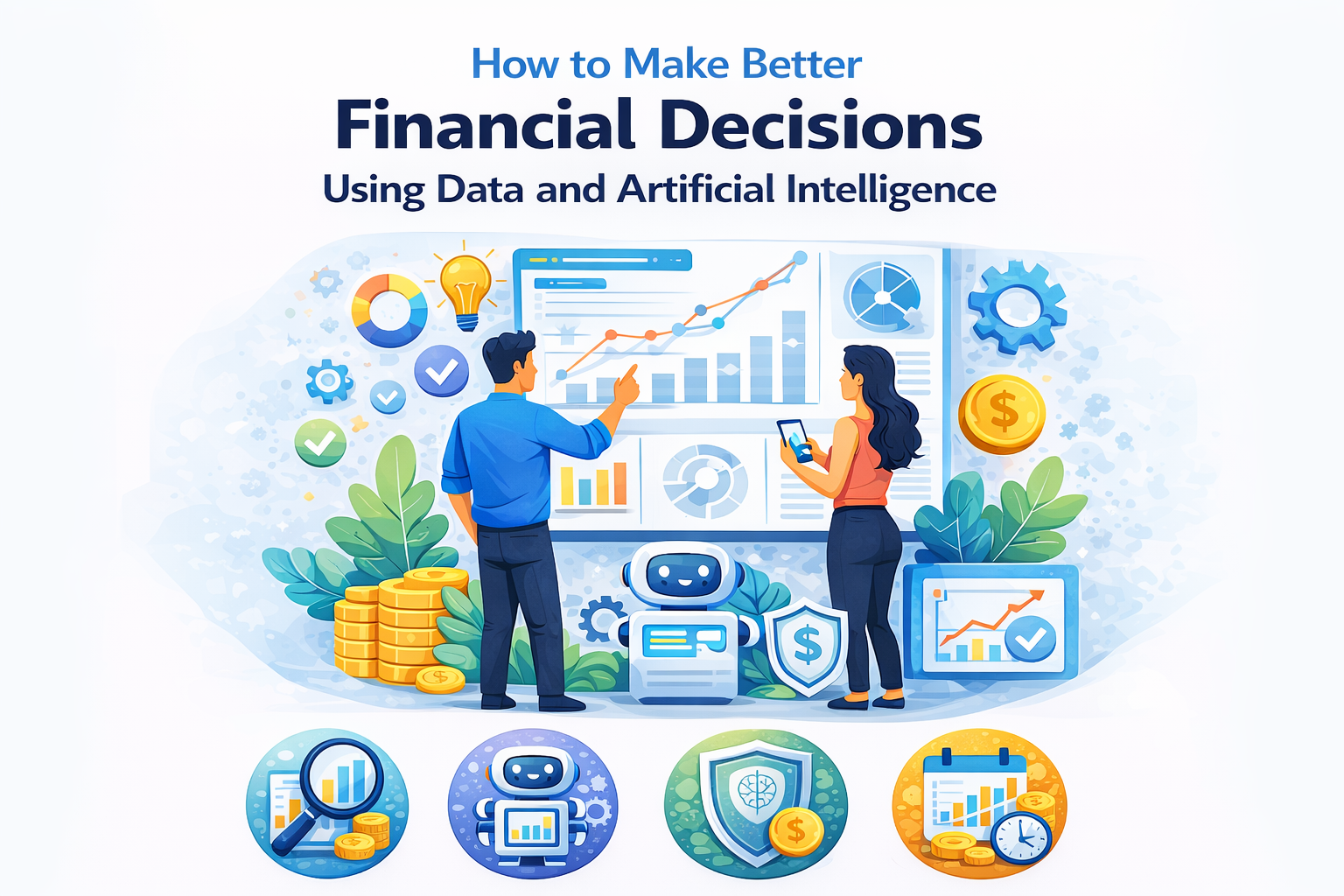
Making financial decisions has always been a challenge. Money is deeply linked to emotions such as fear, security, or ambition, which often leads to impulsive mistakes. Today, however, there is an advantage that was not previously available to most people: the use of data and artificial intelligence (AI) to make decisions with greater clarity and less uncertainty.
The combination of financial data and AI does not eliminate risk, but it reduces improvisation and improves the quality of decisions. In a complex economic environment, this difference can be decisive.
The Problem of Deciding Without Data
Many financial decisions are made without complete information. Daily expenses, savings, loans, or investments are often based on subjective perceptions rather than real data. The result is usually the same: lack of control and financial stress.
Deciding without data is like driving without looking at the dashboard. It may work for a while, but sooner or later problems appear. Without measurable indicators, it becomes difficult to detect overspending, assess debt levels, or determine whether savings goals are realistic. Over time, small miscalculations can accumulate and create significant financial instability.
The Role of Financial Data
Financial data reflects the real behavior of money: income, expenses, debts, consumption habits, and savings capacity. Analyzing this data allows you to:
- Identify spending patterns
- Detect hidden risks
- Measure financial progress
- Evaluate past decisions
When properly interpreted, data stops being just numbers and becomes useful information. For example, tracking monthly expenses over time can reveal recurring subscriptions, seasonal spending spikes, or lifestyle inflation. With structured data, individuals and businesses alike can set measurable goals, compare performance across periods, and create strategies based on evidence rather than assumptions.
How Artificial Intelligence Transforms Data into Decisions
Artificial intelligence has the ability to analyze large volumes of data in real time and identify relationships that a person would hardly detect. In finance, this makes it possible to:
- Anticipate liquidity problems
- Simulate future scenarios
- Recommend personalized adjustments
- Detect unhealthy financial behaviors
AI does not decide for the person, but it improves the context in which decisions are made. Advanced algorithms can evaluate thousands of variables simultaneously, including market trends, historical spending behavior, and risk tolerance. This enables more accurate forecasting and strategic planning. For businesses, AI-driven analytics can optimize cash flow management, investment allocation, and pricing strategies. For individuals, it can suggest smarter saving methods or alert them when spending deviates from established goals.
More Objective Financial Decisions
One of the greatest benefits of AI is reducing emotional impact. Fear of losing money or excitement about an opportunity often distorts judgment. Data-based systems provide a more objective and balanced perspective.
This is especially useful in times of economic uncertainty, when emotions tend to dominate decisions. By relying on structured analysis rather than impulse, individuals can avoid panic selling, excessive borrowing, or speculative investments. Objective insights encourage disciplined, long-term financial planning instead of short-term reactions.
Dynamic and Adaptive Budgets
Unlike traditional budgets, data- and AI-based budgets adjust in real time. Changes in income or expenses generate automatic alerts and recommendations.
This allows for quick decision-making and helps prevent imbalances before they become major problems. For instance, if income decreases unexpectedly, an AI-driven system can immediately suggest expense reductions or alternative allocation strategies. Over time, these adaptive systems learn from behavior patterns, making recommendations increasingly precise and aligned with personal or organizational goals.
Responsible Use of Financial AI
Although AI offers significant advantages, it should not be used blindly. It is essential to:
- Understand what data it uses
- Know its limitations
- Verify recommendations
- Maintain independent judgment
The best financial decision emerges when technology supports, but does not replace, human judgment. Transparency, data privacy, and ethical considerations must also be part of the equation. Users should remain aware that algorithms are based on models, which may not fully capture unexpected economic events or personal circumstances.
Data-Driven Financial Education
The use of data and AI promotes a new form of financial education. Learning no longer relies solely on theory, but on personalized and practical information.
Understanding one’s own financial data creates greater awareness and better long-term habits. Interactive dashboards, predictive tools, and automated insights empower individuals to take control of their finances with measurable benchmarks. This approach fosters accountability and encourages continuous improvement.
Conclusion
Making better financial decisions no longer depends solely on intuition. The use of data and artificial intelligence helps reduce errors, anticipate risks, and act with greater confidence.
In a world where information is abundant, knowing how to interpret it correctly becomes a key financial advantage. As technology continues to evolve, those who combine analytical tools with critical thinking will be better positioned to navigate uncertainty, build resilience, and achieve sustainable financial growth.