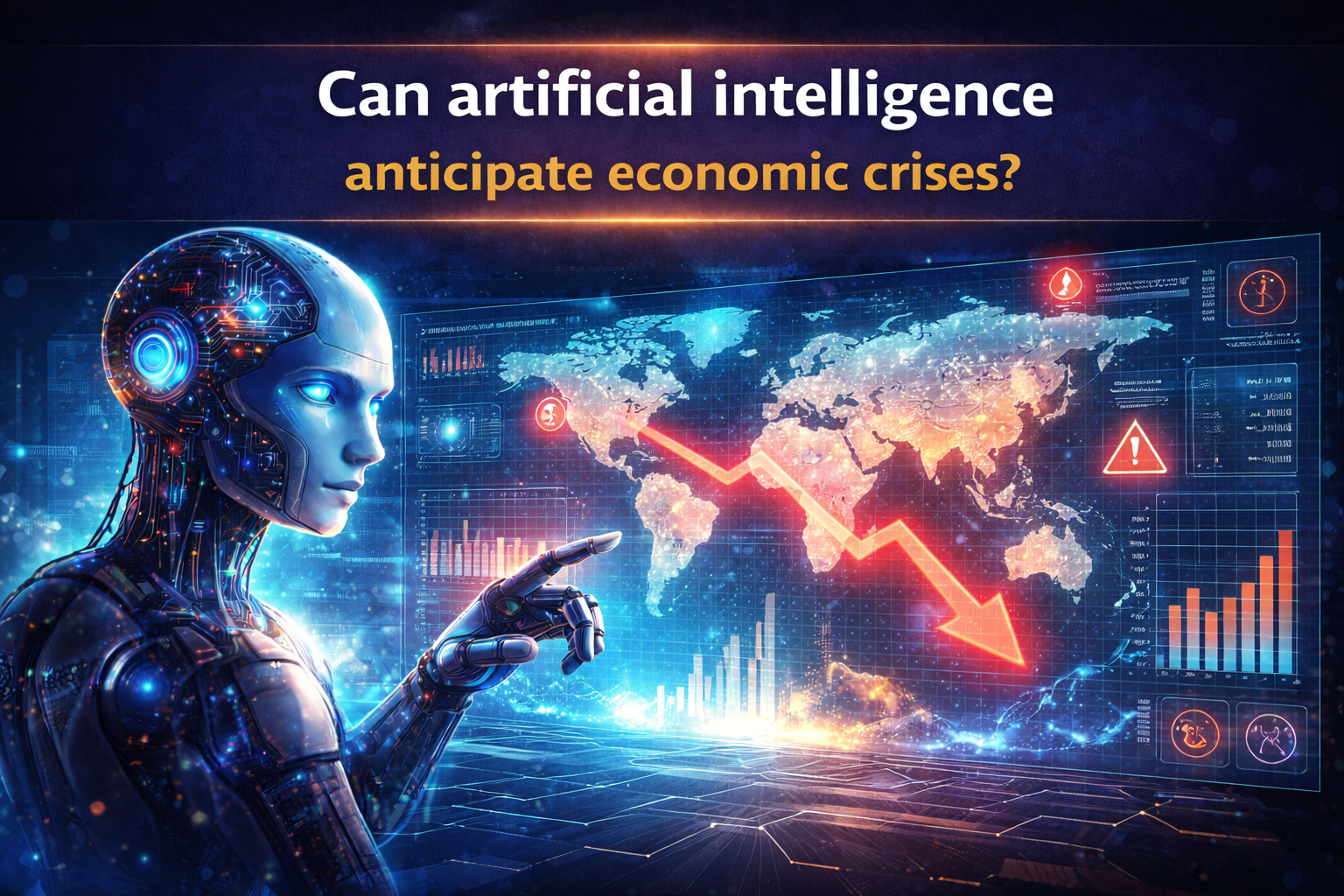
The possibility of anticipating an economic crisis has been, for decades, one of the ultimate goals for economists, governments, and investors alike. Accurately predicting when a recession will occur would allow for preventive measures, the reduction of financial losses, and the mitigation of social impacts. In recent years, Artificial Intelligence (AI) has emerged as a promising tool to analyze massive volumes of data and detect early signs of economic imbalances. However, the key question remains: can AI truly foresee economic crises?
The Historical Challenge of Market Forecasting
Economic crises are typically the result of multiple interacting factors: asset bubbles, excessive debt, shifts in monetary policy, geopolitical tensions, and irrational market behavior. This complexity has caused even the most advanced economic models to fail in anticipating events like the 2008 global financial crisis or the economic shocks of the pandemic. Traditional models rely on lagging indicators—GDP growth, unemployment, and inflation—which often only react once a downturn is already underway, limiting their utility as early warning systems.
What AI Brings to Economic Analysis
The primary advantage of AI is its ability to process vast datasets from multiple sources and find non-linear relationships that are invisible to classical statistical models. Machine learning systems can analyze millions of data points in real-time, adjusting predictions as environmental conditions shift. Beyond traditional macroeconomics, AI incorporates “Alternative Data,” such as credit flows, satellite imagery of industrial activity, and real-time shipping logistics. This diversity allows for a more holistic view of economic health. For example, changes in consumer sentiment detected through natural language processing (NLP) on digital media can signal a loss of confidence long before it shows up in official employment reports.
Strategic Deep Dive: The “Black Swan” Limitation and the Reflexivity Trap
To understand the true predictive power of AI in 2026, we must address the “Black Swan” Paradox. AI models are inherently “backward-looking”; they learn from historical patterns to predict future outcomes. However, the most devastating economic crises are often caused by unprecedented events—such as a novel virus, a breakthrough in fusion energy, or a sudden geopolitical realignment—that have no historical precedent. This is known as Structural Break Risk. When the fundamental rules of the economy change, an AI trained on the “old world” becomes not only useless but potentially dangerous, as it provides a false sense of mathematical certainty in a chaotic environment.
A critical strategic concept in 2026 is Economic Reflexivity. This theory suggests that the act of predicting an event can actually change the event itself. If a dominant AI model used by major central banks and hedge funds predicts a crash in six months, those actors will sell their assets today to mitigate risk. This collective action causes the crash to happen now rather than in six months, or perhaps prevents it entirely by forcing an early correction. This creates a Feedback Loop where the observer influences the observed. As AI becomes more prevalent, the market doesn’t just become more efficient; it becomes more “nervous,” as algorithms react to each other’s predictions in a digital echo chamber.
Furthermore, we must analyze Deep Learning Interpretability, often called the “Black Box” problem. In 2026, regulators are increasingly wary of Algorithmic Accountability. If an AI triggers a massive sell-off or suggests a radical hike in interest rates, policymakers need to know why. Traditional econometrics provides a clear “paper trail” of causality (e.g., “Inflation rose because of energy costs”). Deep neural networks, however, may identify a correlation between obscure variables—like the price of cardboard boxes in Southeast Asia and mid-tier tech valuations—without providing a logical explanation. This lack of transparency makes it difficult for human leaders to trust AI during a moment of high-stakes panic.
Finally, for the strategic investor, the most valuable use of AI is not in predicting the “When,” but in measuring Systemic Fragility. Rather than trying to time the exact moment of a crash, advanced AI models are now used to conduct “Stress Tests” on global supply chains and debt structures. By simulating millions of “What-If” scenarios, AI identifies which links in the global economy are the weakest. In this sense, AI acts as a Financial Stress Meter. It tells you when the forest is dry and prone to fire, even if it cannot predict exactly which lightning strike will start the blaze. This allows for the construction of Antifragile Portfolios—investments that are designed to benefit from, or at least survive, the very volatility that the AI detects.
Predictive Models and Early Warning Signals
In recent years, financial institutions have developed AI models that calculate probabilities of a slowdown across various time horizons. These systems analyze the yield curve, credit evolution, and market volatility simultaneously. When multiple signals activate, the models generate alerts. While this doesn’t pinpoint an exact date, it identifies fragile economic environments, which is invaluable for risk management.
Limitations and the Risk of Overreliance
Despite these advances, AI has significant limitations. Beyond its dependence on historical data, there is the risk of Overfitting, where a model becomes so perfectly tuned to past data that it fails to generalize to new situations. This can lead to “False Positives”—predicting a crisis that never happens—which can be costly for investors who miss out on growth opportunities. Additionally, if all market participants use similar AI models, their herd behavior could amplify market fluctuations, increasing volatility rather than reducing it.
Conclusion: A Strategic Support Tool
AI is significantly improving our ability to detect economic vulnerabilities and identify complex patterns that precede recessions. This represents a major leap over traditional methods that often react too late. However, the economy remains a dynamic system influenced by human emotion and unpredictable politics. AI should not be seen as a crystal ball, but as an advanced early warning system. Anticipating a crisis does not always mean avoiding it, but it marks the difference between a panicked reaction and a strategic response. As technology integrates more data, these models will improve, but the combination of AI, traditional analysis, and human judgment will remain essential in an increasingly complex world.