Market Volatility: Strategies to Protect Capital in Unstable Environments
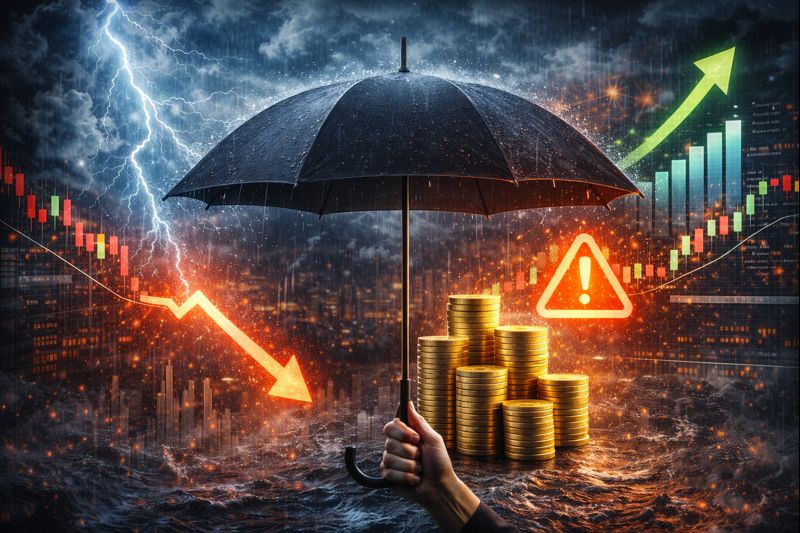
Volatility is a natural characteristic of financial markets, but during certain periods, it can intensify and generate sharp fluctuations in asset prices. Factors such as shifts in monetary policy, geopolitical conflicts, persistent inflation, or economic slowdowns often trigger episodes of uncertainty that test the stability of investment portfolios. In this context, protecting capital becomes a priority for many investors, especially those with conservative profiles or short-to-medium-term financial goals.
Understanding Volatility and Its Impact
Volatility measures the magnitude and frequency of changes in an asset’s price. A volatile market does not necessarily mean constant losses, but rather rapid and unpredictable movements, both upward and downward. The primary risk in these environments is not just the price drop, but impulsive decisions that lead to selling during moments of panic, consolidating losses that might have otherwise recovered over time.
The Importance of Diversification
One of the most effective strategies for reducing the impact of volatility is portfolio diversification. Distributing investments across different asset classes—stocks, bonds, cash, commodities, or alternative assets—allows an investor to offset losses in one sector with better performance in another. Beyond asset types, it is also advisable to diversify by geographical regions and economic sectors.
Strategic Deep Dive: Volatility Metrics and the Psychology of Risk in 2026
To effectively manage capital in 2026, one must move beyond the basic concept of volatility and look at the VIX Index (the “Fear Gauge”) and the Standard Deviation of a portfolio. Volatility is often mathematically represented by Sigma ($\sigma$). In a normal market distribution, an asset’s price stays within one standard deviation of its mean roughly 68% of the time. However, in 2026, we are seeing an increase in “Fat-Tail” events—extreme market moves that occur more frequently than traditional models predict.
A critical strategic tool for the modern investor is the Sharpe Ratio, which measures the risk-adjusted return of an investment. The formula is expressed as:
$$S = \frac{R_p – R_f}{\sigma_p}$$
Where $R_p$ is the portfolio return, $R_f$ is the risk-free rate, and $\sigma_p$ is the portfolio’s standard deviation. In a volatile year like 2026, a high Sharpe Ratio is more valuable than high absolute returns, as it indicates the investor is not taking excessive “unit of risk” for every “unit of gain.”
Furthermore, we must address Behavioral Finance and the concept of Myopic Loss Aversion. This is the tendency of investors to react negatively to short-term losses even when their long-term goals are intact. In 2026, the constant “noise” from AI-driven news cycles amplifies this bias. To combat this, strategic investors use Bracket Orders or Volatility-Targeting funds that automatically reduce exposure when $\sigma$ exceeds a certain threshold. This removes the “human element” from the decision-making process during a crash.
Finally, we are witnessing the rise of “Negative Correlation Assets” in 2026. Traditional bonds have become more correlated with stocks due to inflation. Consequently, investors are turning to Managed Futures and Gold, which historically show a low or negative correlation ($r \approx -0.2$ to $-0.5$) with the S&P 500 during periods of high stress. By adding these “Amortiguadores” (buffers) to a portfolio, you essentially buy a “Vol-Insurance” policy that pays off exactly when your equity positions are suffering. This isn’t just about avoiding losses; it’s about maintaining the “Dry Powder” (liquidity) necessary to buy high-quality assets at deep discounts when the market eventually bottoms out.
Maintaining Liquidity and Gradual Investment
In unstable markets, keeping part of the portfolio in liquid assets like cash or short-term instruments offers two key advantages: risk reduction and the ability to capitalize on opportunities. This leads to the strategy of Dollar-Cost Averaging (DCA), or periodic investment, which involves contributing capital regularly regardless of market levels. This approach averages the purchase price over time and reduces the anxiety of trying to “time the market.”
Prioritizing Defensive Assets and Rebalancing
During periods of high uncertainty, certain sectors tend to behave more stably. These include high-quality bonds, fixed-income funds, and “defensive” stocks in sectors like utilities, healthcare, or consumer staples. These assets act as buffers. However, because volatility can shift the original weightings of your portfolio, Rebalancing is essential. It forces the discipline of “selling high” (the assets that grew) and “buying low” (those that dipped), returning the portfolio to its intended risk level.
Conclusion: Discipline and the Long-Term Horizon
Protecting capital in unstable markets is not just about choosing the right assets; it’s about maintaining a consistent and disciplined strategy. The most powerful tool against volatility is Time. Historically, markets tend to recover, and investors with long horizons can withstand temporary fluctuations. By combining diversification, liquidity, and periodic rebalancing, it is possible to navigate 2026’s choppy waters without sacrificing long-term growth