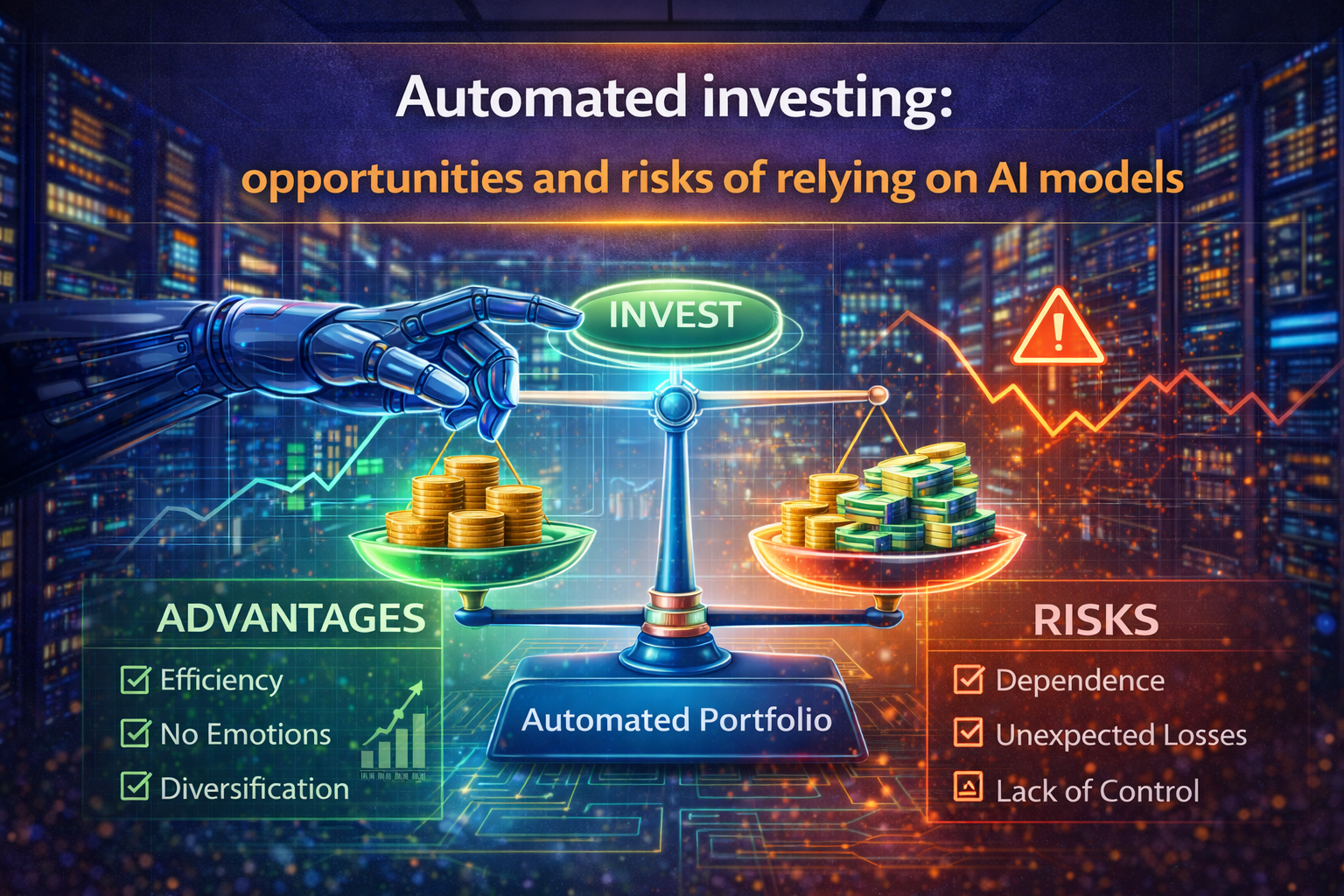
AI-Driven Automated Investing: Transforming Financial Decision-Making
Automated investing powered by Artificial Intelligence (AI) is profoundly transforming how decisions are made in financial markets. What once relied almost entirely on human analysis and the experience of professional managers is now increasingly supported by systems capable of processing enormous volumes of information and executing operations automatically. This evolution has opened new opportunities to improve efficiency and market access, but it has also introduced risks that investors must understand before fully delegating their decisions to algorithmic models.
How Automated Investing Works
Automated investing is based on algorithms that follow programmed rules or machine learning models. Some systems use predefined strategies, such as rebalancing portfolios when certain asset percentages are altered or buying when a technical indicator reaches a specific level. Others, more advanced, employ AI to detect complex patterns in historical and real-time data, adjusting their strategies as market conditions change. These models can analyze traditional financial information but also alternative data, such as news, consumer behavior, or social media signals.
Opportunities: Efficiency, Discipline, and Access
One of the main benefits is the elimination of the emotional factor. Emotions often lead to impulsive decisions, like selling in panic or buying in euphoria. Algorithms follow their rules without being influenced by fear or greed. Execution speed is another advantage, allowing systems to react in milliseconds. Additionally, automation has contributed to the democratization of financial tools through robo-advisors, allowing small investors to access diversified portfolios at low costs.
Strategic Deep Dive: The Algorithmic Frontier and the “Black Box” Challenge in 2026
To master the automated landscape of 2026, we must look at the Architecture of Predictive Models. Most modern AI systems utilize Deep Learning and Recurrent Neural Networks (RNNs) to forecast price movements. Mathematically, these models attempt to minimize a Loss Function which measures the difference between the predicted price ($\hat{y}$) and the actual price
In a volatile year like 2026, the challenge is that the “Global Minimum” of this function in historical data may not represent the future reality. This leads to the phenomenon of Overfitting, where the model is so perfectly tuned to the past that it becomes “blind” to new market regimes.
A critical strategic concern for 2026 is the “Black Box” Problem. As algorithms become more autonomous, they often identify correlations that lack human logic. For example, an AI might find a correlation ($r \approx 0.85$) between satellite data of cargo ships in the Suez Canal and the volatility of mid-cap tech stocks. While statistically significant, if the underlying causal link is weak, the model may collapse during a “Regime Shift”. This is why the industry is moving toward Explainable AI (XAI)—systems designed to provide a human-readable “Rationale” for every trade executed.
Furthermore, we must address Algorithmic Reflexivity. In 2026, when millions of “Retail Bots” and institutional “HFT” (High-Frequency Trading) systems use similar momentum-tracking logic, they create a Feedback Loop. If a minor dip triggers a “Sell” signal across multiple platforms, the combined selling pressure creates a self-fulfilling prophecy of a crash. To protect your capital, it is essential to look for Non-Correlated Algos. If your automated strategy is doing exactly what everyone else’s is, you are exposed to Systemic Liquidity Risk.
Finally, consider the Cost of Technology Lag. In the hyper-competitive market of 2026, “Old” robo-advisors that rebalance only once a month are being outperformed by Real-Time Rebalancers. However, these high-frequency adjustments come with a “Hidden Tax”: Transaction Costs and Slippage. Even if an AI identifies a 0.5% profit opportunity, if the bid-ask spread and platform fees total 0.6%, the trade is a net loss. The strategic investor must ensure that their automated partner is optimized for Net-of-Fee Returns, not just gross predictive accuracy. By combining human oversight with AI efficiency, you ensure the machine serves your goals, rather than just chasing digital noise.
Risks: Dependence on History and Technical Failures
Despite the advantages, AI models have limitations. Their dependence on historical data makes them less effective during unprecedented events like pandemics or sudden geopolitical shifts. There is also the risk of Technical and Operational Failures, including software bugs or cyberattacks. Many financial institutions now implement layers of human supervision to mitigate these “Flash Crash” scenarios.
The Role of the Investor in an Automated World
Even with advanced technology, the investor’s role remains fundamental. Defining clear goals, a time horizon, and a risk tolerance is essential before choosing any system. Automated investing works best as part of a diversified strategy, combining different asset types and management approaches. It is recommended to periodically review the performance of these models and never assume that a strategy profitable in the past will remain so in the future.
Conclusion: A Complement, Not a Total Substitute
Artificial Intelligence is changing the way we invest and will continue to gain prominence. However, it should not be considered an infallible solution. Financial markets are still influenced by human decisions and unpredictable events. In this context, automated investing should be understood as a complement to human analysis. Used responsibly, it improves efficiency and reduces emotional errors, but total reliance on AI without personal criteria can increase risks rather than reduce them.