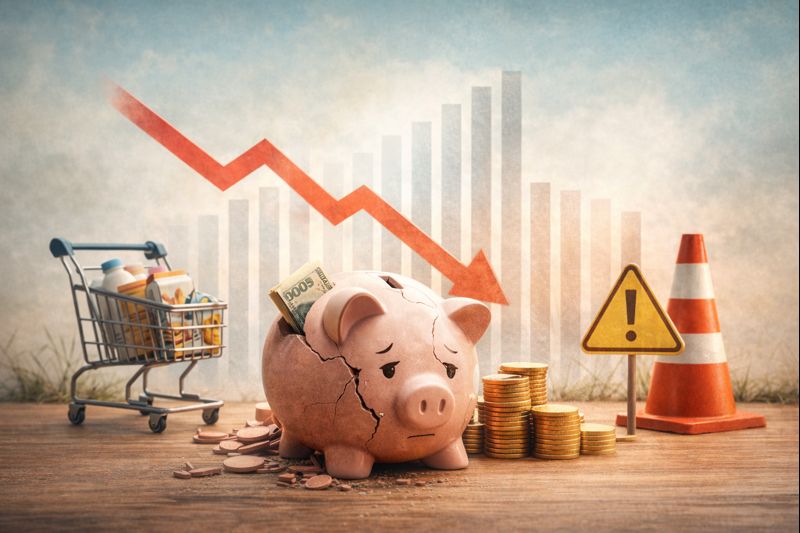
The global economy faces a complex scenario marked by moderate growth and weaker-than-usual consumption. After several years of sharp economic adjustments, elevated inflation, and shifts in monetary policy, both businesses and households are displaying increased caution in their financial decisions. This environment poses significant challenges for economic recovery and the stability of various productive sectors.
Growth Losing Momentum
Economic growth primarily depends on investment, consumption, and trade. In the current context, these three engines are advancing with less vigor. Companies tend to postpone expansion projects given the uncertainty regarding future demand, while governments have less fiscal room to stimulate the economy due to high debt levels accumulated in recent years. Furthermore, financial conditions remain more restrictive than in the previous decade. Although interest rates have begun to stabilize in some countries, the cost of credit remains high compared to previous years, hindering both business investment and household spending. This slower growth does not necessarily imply a widespread recession, but rather an environment of limited expansion where economic progress is uneven across regions and sectors.
Weak Consumption and Shifting Spending Habits
Consumption is one of the primary pillars of economic activity, especially in economies where it represents a significant portion of the Gross Domestic Product. However, consumers have reduced their spending levels, prioritizing basic needs and postponing high-value purchases such as homes, automobiles, or durable goods. This behavior largely responds to the cumulative impact of inflation on family budgets. Even if prices grow at a slower pace than in previous years, the overall level remains high, forcing families to allocate a larger proportion of their income to essential expenses like food, energy, and services. Additionally, job uncertainty in some sectors has led to an increase in precautionary savings, as individuals prefer to reserve part of their income fearing potential employment adjustments or wage reductions.
Strategic Deep Dive: The “K-Shaped” Consumer and the Debt Service Trap
To fully grasp the economic friction of 2026, we must analyze the “K-Shaped” Consumption Divergence. While aggregate data shows “moderate growth,” the reality is split. High-income households, buoyed by the AI-driven equity boom and high yields on cash reserves, continue to spend on luxury services. Conversely, the middle and lower classes are caught in a Debt Service Trap. During the low-rate era, floating-rate debt was manageable; today, even as central banks pause hikes, the “lag effect” of past increases is hitting home renewals and credit card rollovers. This creates a Consumption Ceiling, where any marginal increase in wages is immediately swallowed by interest payments rather than flowing back into the retail economy.
A critical strategic factor this year is Inventory Psychology. In 2024 and 2025, corporations dealt with “Bullwhip Effect” surpluses. In 2026, they have pivoted to Lean Logistics, reducing stock to protect margins. While this helps corporate balance sheets, it slows down the industrial engine, leading to the “moderate growth” we observe. Furthermore, we are seeing the rise of “Stingy Consumption”—a behavioral shift where consumers no longer view inflation as temporary. This psychological scarring leads to a permanent reduction in discretionary volume, a phenomenon economists call Consumption Hysteresis. Even if prices were to drop tomorrow, the habit of “buying less” has become structurally embedded in the consumer psyche.
Moreover, the Geoeconomic Fragmentation of 2026 adds a “Hidden Tax” on consumption. As “Friend-shoring” replaces globalized efficiency, the baseline cost of electronics and textiles has shifted upward. This is not traditional inflation driven by demand, but Cost-Push Resilience Pricing. Consumers are paying a premium for supply chain security, which acts as a persistent drag on their purchasing power. For the strategic investor, the focus must shift from “Growth at any Cost” to “Quality of Earnings.” Companies that can maintain margins without losing volume in this “Weak Consumption” era are the true outliers.
Finally, we must consider the Fiscal Drag. With sovereign debt-to-GDP ratios at historic highs in the G7, the era of “stimulus checks” is over. Governments are entering a period of Fiscal Consolidation, meaning the public sector will no longer act as the “Buyer of Last Resort.” This leaves the global economy reliant on private productivity gains—specifically from Generative AI integration—to bridge the growth gap. If AI productivity doesn’t scale fast enough to offset weak human consumption, the “Moderate Growth” of 2026 could settle into a long-term Secular Stagnation.
Sectors Hit by the Slowdown
The cooling of consumption does not impact the economy homogeneously. Sectors related to durable goods, tourism, leisure, and retail are usually the first to feel the spending reduction. These businesses face lower sales volumes and narrower profit margins, which can translate into cost adjustments and reduced investment. On the other hand, sectors linked to basic services, healthcare, and essential consumer products tend to show greater resilience. This sectoral difference generates an uneven recovery, where some industries maintain stability while others face significant hardships.
Challenges for Economic Policy
Governments and central banks face a delicate balance. They must prevent inflation from resurging while simultaneously boosting growth and employment. Applying excessive stimulus could reactivate inflationary pressures, while maintaining overly restrictive policies could prolong the slowdown. In this context, fiscal policies tend to be more selective, focusing on strategic sectors, infrastructure, or specific social programs rather than generalized stimulus.
Conclusion: Perspectives for the Remainder of the Year
Economic projections suggest that growth will remain limited in the short term, with a gradual recovery conditioned by the evolution of inflation, monetary policies, and the geopolitical context. Consumption will likely remain contained as households continue to adjust their budgets and prioritize financial stability. In this scenario, the primary challenge will be achieving a balance between price stability and growth stimulus without creating new economic imbalances. For governments, businesses, and consumers alike, prudence and planning will be key to navigating a year marked by caution and adaptation to a more demanding economic environment.