AI in Global Markets: Redefining the Future of the Economy
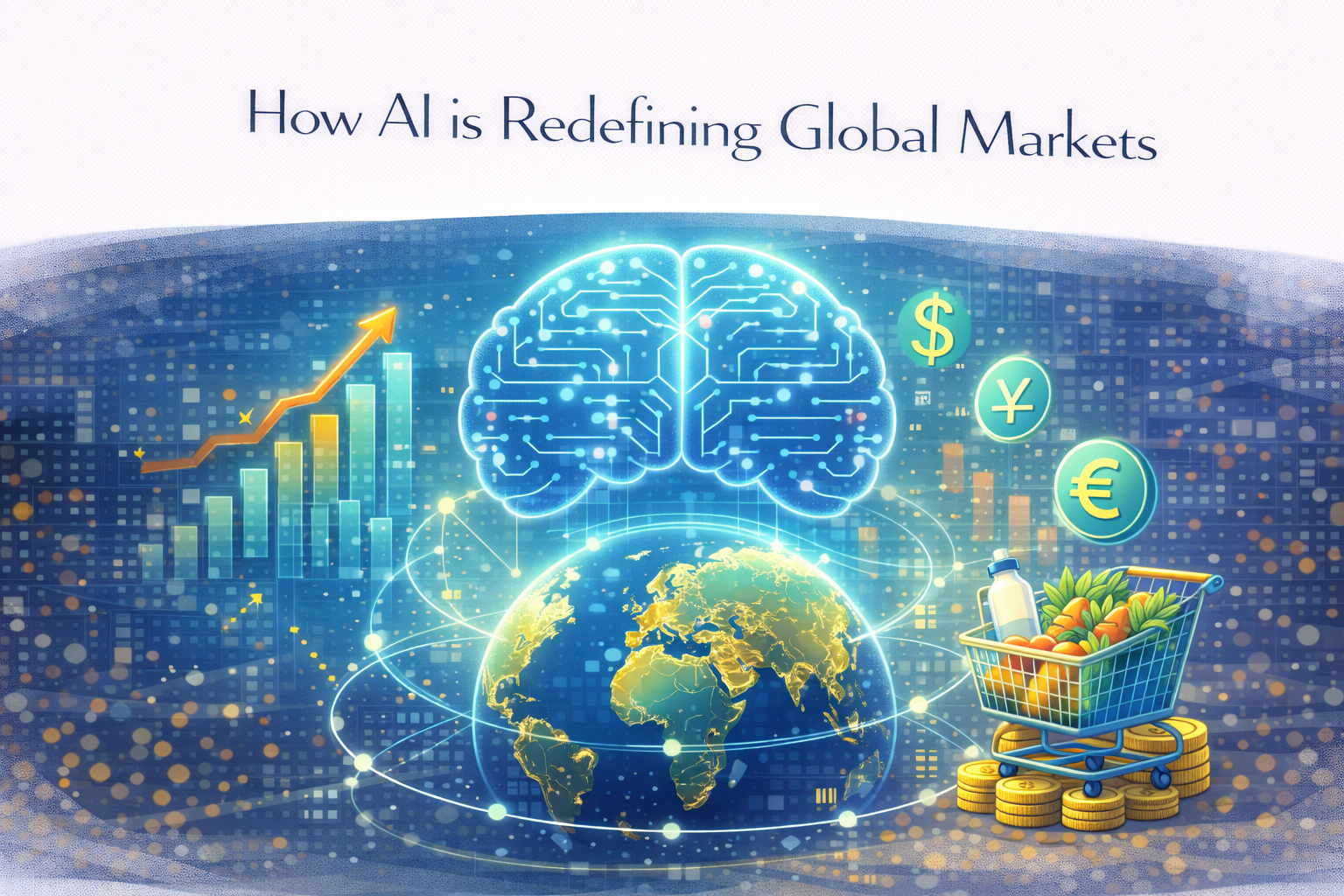
Artificial Intelligence (AI) has ceased to be a futuristic promise and has become a real engine of economic transformation. Today, it directly influences how assets are bought and sold, how companies are managed, how crises are anticipated, and how large-scale financial decisions are made. In this new landscape, global markets no longer move solely based on human factors but are driven by systems capable of processing millions of data points in real-time.
From Intuition to Massive Data Analysis
Traditionally, markets were guided by human analysis, economic reports, and expectations based on past experiences. With the arrival of AI, this approach has changed radically. Current algorithms can analyze historical price trends, real-time economic and political news, social media sentiment, and global macroeconomic indicators. This capability allows for the detection of patterns invisible to the human eye, reacting in fractions of a second and notably accelerating the dynamics of financial markets.
However, we are witnessing a shift toward Alternative Data. Beyond traditional balance sheets, AI now ingests satellite imagery of retail parking lots to predict quarterly sales, or tracks private jet movements to anticipate corporate mergers. This “Information Edge” means that by the time a human reads a headline, an algorithm has already executed thousands of trades based on data that wasn’t even considered “financial” a decade ago. Mastering this data flow is the new frontier of market sovereignty.
Algorithmic Trading and the Speed of the Market
One of the most visible impacts of AI is algorithmic trading, where automated programs execute buy and sell orders without direct human intervention. These systems can perform thousands of transactions per second, capitalizing on minute price variations. While this has created more liquid markets, it has also introduced “Flash Volatility.”
A critical risk in this high-speed environment is the Flash Crash. When multiple algorithms react simultaneously to a specific data trigger, they can create a feedback loop that causes market prices to collapse and recover within minutes. This “Machine-to-Machine” interaction bypasses human reason, highlighting the “Black Box Risk”—the difficulty in understanding exactly why an AI made a specific, high-impact decision. As markets become faster, the gap between “Digital Execution” and “Human Oversight” widens, requiring new layers of “Circuit Breakers” to maintain systemic stability.
Precise Risk Management and International Trade
AI doesn’t just make money; it protects it. Predictive analysis systems help identify financial risks before they fully materialize, such as detecting speculative bubbles or early signs of economic instability. This allows banks and insurers to adjust their strategies with greater anticipation, enhancing the resilience of the financial system.
Furthermore, AI is transforming global trade. Companies use AI to optimize supply chains, predict demand, and select efficient suppliers. Through these systems, companies can:
- Reduce logistical costs and minimize waste.
- Adapt quickly to market changes.
- Personalize regional offers.
This makes international markets more interconnected and competitive, but also more dependent on technology to maintain efficiency. The “Just-in-Time” supply chain is becoming an “AI-Driven Supply Chain,” where algorithms manage the global flow of goods with surgical precision.
Democratization and Systemic Risks
AI has lowered entry barriers for small investors. Digital platforms offer automated analysis and “Robo-advisors” accessible to people without large amounts of capital. This has expanded market participation, though it introduces the risk of users relying on models they don’t fully understand.
Moreover, the massive integration of AI poses Systemic Challenges. When many actors use similar models, decisions become homogeneous, increasing the risk of coordinated sharp movements. Programming errors or data biases can amplify rapidly on a global scale. Regulators are now focusing on the role of algorithms in economic stability, as technology often moves faster than the law, creating “grey zones” where risks are not yet fully controlled.
Employment, Education, and the Future
The labor market is also shifting. Automation and intelligent management systems are reducing certain job types while creating specialized new ones. This generates adaptation challenges for countries, which must invest in Technological Education to remain competitive. Economies that best integrate AI into their productive structure will have a greater capacity for long-term growth.
The future points toward markets that are smarter but significantly more complex. The challenge for investors, companies, and governments will be learning to coexist with this new reality: leveraging AI’s analytical power without losing human control over strategic decisions and economic policies. Technology can optimize processes, but social, ethical, and economic goals remain the responsibility of people.
Conclusion: A Transformation Already in Motion
Artificial Intelligence is not just another tool in global markets; it is a structural factor changing how capital is allocated and risks are managed. Its impact extends from large investment funds to the small investor, and from international trade to local employment. Understanding how AI redefines markets is not just a technological topic but a necessity for anyone who wants to understand the future of the global economy. In this new environment, adaptation is not optional: it is an essential part of remaining competitive in a world increasingly guided by data, algorithms, and automated decisions.