International trade is undergoing a profound structural transformation driven by rising geopolitical tensions, shifts in strategic alliances, and a heightened pursuit of economic security by sovereign nations. For decades, the era of hyper-globalization favored highly integrated supply chains built almost exclusively on cost efficiency. However, the current global context is forcing governments and corporations to rethink their commercial strategies, prioritizing resilience and diversification over immediate profitability.
From Global Integration to Geoeconomic Fragmentation
During the peak of global expansion, companies optimized production chains by seeking the lowest possible labor costs and maximum logistical efficiency. This led to a heavy concentration of manufacturing in specific regions, notably East Asia. However, recent systemic shocks—from pandemic disruptions to regional conflicts—have exposed the fragility of this “Just-in-Time” model.
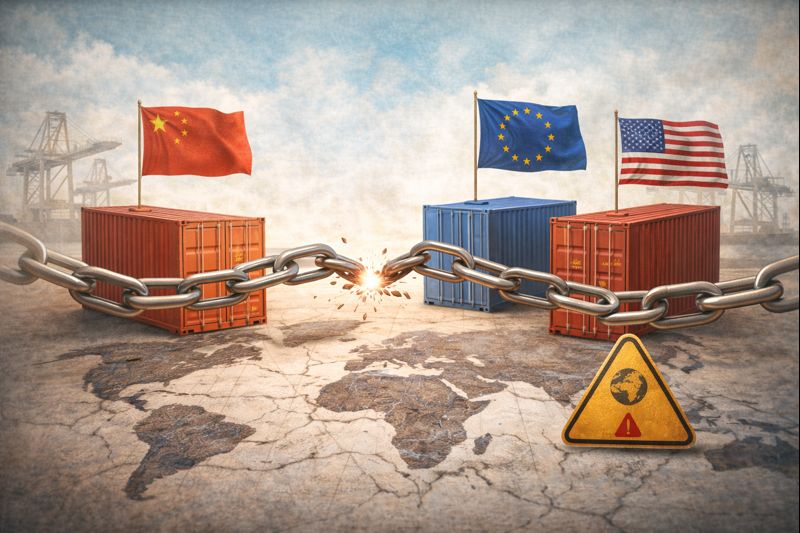
We are now witnessing Geoeconomic Fragmentation, where trade flows are increasingly dictated by political alignment rather than mere comparative advantage. This phenomenon is characterized by the rise of “Trade Blocs” and a move away from the rules-based multilateral system overseen by the WTO. As nations seek to “de-risk” their economies, we see the emergence of a dual-track global economy where Western alliances and emerging blocs develop parallel supply chains. This fragmentation reduces systemic efficiency but aims to provide a buffer against the weaponization of trade.
The Rise of “Friend-shoring” and “Near-shoring”
Multinational corporations are adjusting their footprints through processes known as Near-shoring (moving production to geographically closer countries) and Friend-shoring (relocating to politically aligned allies). The objective is to reduce logistical bottlenecks and decrease exposure to geopolitical blackmail.
This transition marks the shift from a “Just-in-Time” to a “Just-in-Case” inventory philosophy. While this redistribution of trade flows offers massive opportunities for emerging economies with institutional stability and strategic locations (such as Mexico, Vietnam, or Poland), it also carries a significant Efficiency Tax. Producing in an allied nation may be politically safer, but it is often more expensive. This structural change in the cost of production is a primary driver of “Sticky Inflation” in developed economies, as the era of “cheap imported goods” effectively comes to a close.
Strategic Autonomy and the Control of Critical Sectors
A defining feature of this new era is the return of Industrial Policy. Governments are no longer passive observers of the market; they are active architects of production in critical sectors such as semiconductors, rare earth minerals, renewable energy, and pharmaceuticals.
The doctrine of “Strategic Autonomy” is now a cornerstone of national defense. This involves massive subsidies (such as the CHIPS Acts seen in various regions), export restrictions on foundational technologies, and stricter vetting of foreign direct investment (FDI). Technology has become the primary “front line” of trade tensions. The decoupling of high-tech sectors—specifically in Artificial Intelligence and telecommunications—reflects an inextricable link between commercial policy and national security. This “Technological Sovereignty” prevents the free flow of innovation but safeguards the digital infrastructure of nations.
Impacts on Prices, Investment, and Global Stability
The reconfiguration of trade has direct consequences for the global consumer and the institutional investor. For companies, managing Geopolitical Risk is no longer an elective skill; it is a core competency. Strategies now include:
- Supplier Redundancy: Moving from a single-source to a multi-source model.
- Vertical Integration: Bringing critical component manufacturing back “in-house.”
- Logistical Regionalization: Shortening the physical distance between production and the final consumer.
For investors, this reshuffling creates “Winners and Losers.” Industries linked to domestic infrastructure, defense, and local energy production are seeing record inflows, while companies heavily dependent on long, fragile global chains face increased volatility. Furthermore, the role of Regional Trade Agreements is expanding as multilateralism stumbles. These “Power Blocs” offer protection against external shocks but may deepen the global divide into spheres of economic influence.
Conclusion: A New Equilibrium of Resilience
International trade is not disappearing; it is being re-engineered for a more volatile century. The era of “Efficiency at any cost” has been replaced by the era of “Security and Resilience.” This new equilibrium will be gradual and uneven, requiring significant capital investment and regulatory adaptation. While the short-term result may be higher costs and slower growth, the long-term goal is a more robust global system—one that is less vulnerable to extreme disruptions and better aligned with the strategic realities of the modern world.