entral Banks: The High-Stakes Balancing Act of 2026
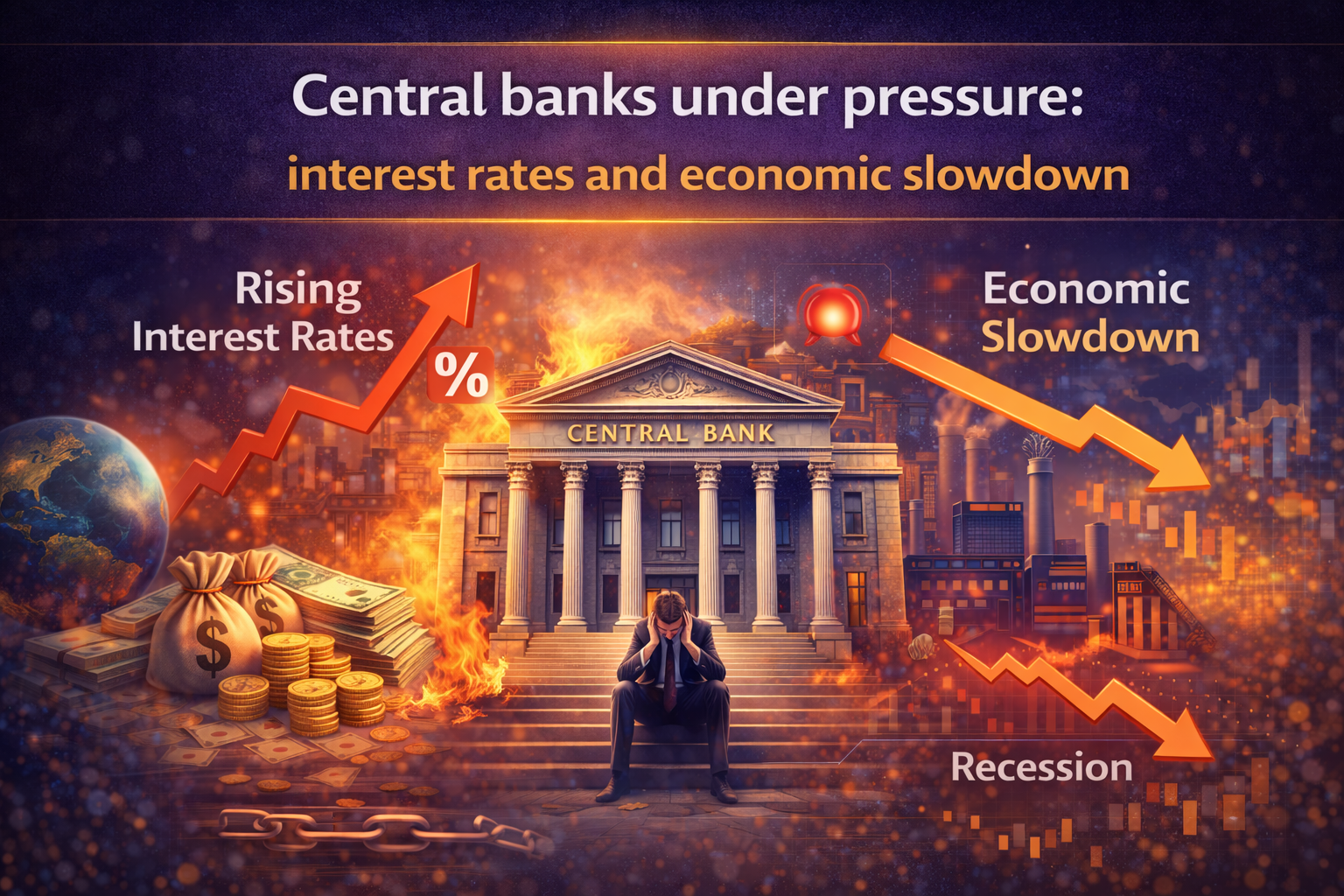
Central banks are currently navigating one of the most complex positions in recent history. Following a prolonged period of high inflation, monetary authorities have implemented restrictive policies by raising interest rates to curb consumption and stabilize prices. However, these same measures have contributed to an economic slowdown that now poses new risks to growth and employment. The challenge lies in finding the “Goldilocks” zone: controlling inflation without triggering a severe economic contraction.
Why Central Banks Raised Rates
Interest rates are the primary lever of monetary policy. When inflation rises, central banks increase rates to make credit more expensive, thereby reducing spending and moderating demand. This helps cool down price increases but also decelerates the economy.
In recent years, inflation was fueled by a “perfect storm”: supply chain disruptions, soaring energy costs, previous fiscal stimulus, and shifting consumer patterns. Faced with this, central banks tightened policy to prevent inflation from becoming “sticky” or structural.
Strategic Deep Dive: The “Lag Effect” and the Neutral Rate ($r^*$)
To understand the 2026 dilemma, we must look at the Time Lag of Monetary Policy. Changes in interest rates do not hit the economy instantly; they typically take 12 to 18 months to fully manifest in GDP and employment figures. This means central banks are effectively driving a car by looking through the rearview mirror. If they wait until they see a recession to cut rates, they might already be too late to stop it.
A critical concept in 2026 is the Neutral Interest Rate, often denoted as $r^*$ (r-star). This is the theoretical rate that neither stimulates nor contracts the economy. When the actual policy rate is above $r^*$, policy is “restrictive.” The difficulty is that $r^*$ is not a fixed number; it shifts based on productivity, demographics, and global capital flows. In 2026, many economists argue that $r^*$ has risen due to the massive investments required for the Green Transition and AI Infrastructure. If central banks miscalculate where $r^*$ sits, they risk keeping rates “too high for too long,” crushing the very industries meant to drive future growth.
Furthermore, we must address Financial Stability Risks. High rates put immense pressure on “zombie companies”—firms that could only survive in a low-rate environment. As these companies struggle to refinance their debt in 2026, central banks face a “Contagion Risk.” If they keep rates high to fight the last remnants of inflation, they might trigger a wave of corporate defaults that could destabilize the banking sector. This creates a Dual-Mandate Conflict: fighting inflation vs. maintaining financial stability.
Finally, the role of Quantitative Tightening (QT) cannot be ignored. Besides raising rates, central banks are shrinking their balance sheets by selling off the bonds they bought during the pandemic. This removes liquidity from the system, acting as a “silent” rate hike. For the strategic investor, the interplay between the headline interest rate and the shrinking money supply ($M2$) is the real metric to watch. If liquidity dries up too fast, market volatility spikes, regardless of what the “official” interest rate says.
Effects of High Rates on the Economy
Elevated rates impact every level of society. For households, they increase the cost of mortgages and credit cards, eating into discretionary income. For businesses, the “Cost of Capital” rises, stalling expansion and hiring.
Sectors like construction and retail are the most sensitive. When credit is expensive, large projects are shelved, and consumer durables (cars, appliances) see a drop in sales. While this cooling is intentional to fight inflation, an over-adjustment can lead to a “Hard Landing”—a full-blown recession.
The Dilemma: Inflation vs. Growth
The primary challenge is timing the “pivot”—the move from raising to cutting rates.
- Cutting too early: Risks an “Inflationary Bounce” where prices surge again, destroying credibility.
- Cutting too late: Risks a deep recession and a spike in unemployment.
Central banks must rely on “Forward Guidance,” signaling their future intentions to the markets to reduce sudden shocks. However, in an era of geopolitical tensions and energy shifts, “Data Dependency” has become the new mantra. They won’t move until the numbers (CPI, PCE, Labor reports) give them a clear green light.
Conclusion: A Difficult but Necessary Balance
In the coming months of 2026, attention will remain fixed on how inflation, employment, and growth evolve. These factors will determine if central banks maintain their restrictive stance or begin a gradual “easing” process. For households and investors, this environment demands financial caution and a focus on risk-adjusted returns. The goal of the central bank is not to eliminate risk, but to manage it so the economy can achieve a “Soft Landing.” Prudence, planning, and adaptation remain the key strategies for navigating this high-interest-rate world.