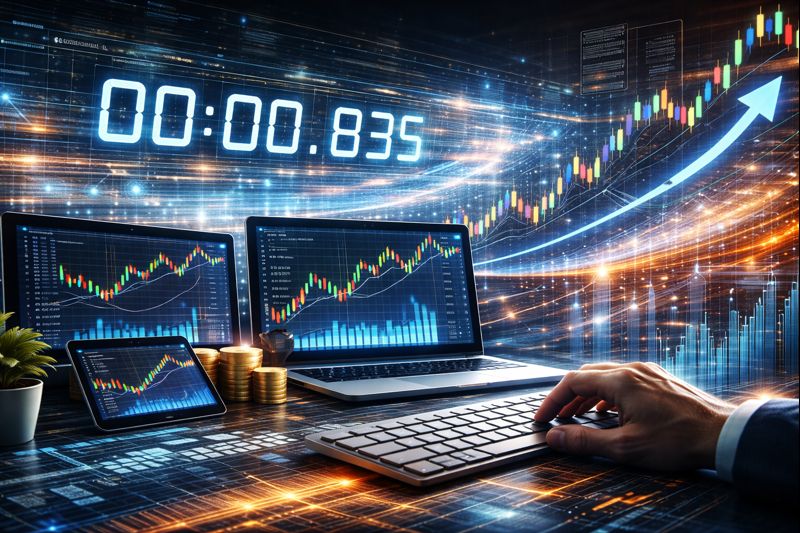
The stock market has undergone a profound structural shift driven by high-speed algorithms. Today, the vast majority of trades executed globally are not performed by humans shouting on a floor, but by automated systems capable of analyzing data and making decisions in fractions of a second. This evolution has redefined price formation, risk management, and the way both large institutions and retail investors participate in the financial ecosystem.
From Traditional Negotiation to Algorithmic Trading
For most of the 20th century, stock trading was a manual process. Traders negotiated directly on exchange floors, using physical signals and verbal agreements. As markets digitized, orders began to be executed electronically, opening the door for mathematical models to automate investment strategies.
Algorithmic trading relies on software that follows specific rules to buy or sell assets when certain conditions are met. These rules can be based on price action, volume, technical indicators, or even macroeconomic events. Unlike humans, algorithms can monitor hundreds of markets simultaneously and react instantly without emotional bias.
Speed as a Competitive Advantage: The World of HFT
In today’s environment, speed is the ultimate currency. In a specific segment known as High-Frequency Trading (HFT), operations are executed in milliseconds or even microseconds. This allows firms to exploit tiny price discrepancies that exist for only an incredibly brief window.
To achieve this, investment firms pour massive resources into technological infrastructure. A common practice is Co-location, where firms place their servers in the same data center as the stock exchange’s engines to minimize “latency”—the time it takes for a signal to travel.
While these strategies seek only a fraction of a cent in profit per share, the sheer volume of transactions—millions per day—can generate significant revenue. However, this technological arms race has created high barriers to entry, effectively turning the market into a battle of hardware and elite engineering.
Strategic Deep Dive: Market Liquidity, Flash Crashes, and the “Black Box” Risk
To understand the 2026 market landscape, we must analyze the Dual Nature of Algorithmic Liquidity. On one hand, algorithms act as “Market Makers,” constantly providing buy and sell quotes. this tightens the Bid-Ask Spread, making it cheaper for everyone—including you—to trade. However, this liquidity is often “phantom liquidity.” In moments of extreme systemic stress, algorithms are programmed to shut down simultaneously to protect capital. This creates a Liquidity Vacuum, leading to a Flash Crash.
A critical strategic concept here is the “Black Box” Risk. As we move from simple rule-based code to Machine Learning (ML) and Neural Networks, even the programmers may not fully understand why an algorithm decided to dump a position. These models identify patterns in “Alternative Data”—such as satellite imagery of retail parking lots or sentiment analysis of millions of social media posts—to predict moves before they happen. This creates a Geoeconomic Fragmentation of information; those with the best AI “see” a different reality than those using traditional balance sheets.
Furthermore, we must consider the Systemic Feedback Loop. When multiple algorithms use similar “trend-following” logic, they can amplify a minor sell-off into a catastrophic collapse. To counter this, global regulators have introduced Circuit Breakers—automated pauses that stop trading when a stock drops by a certain percentage (e.g., 7% or 13%) within a short window. This is a manual “human” override designed to inject sanity back into a digital stampede.
For the retail investor, the Opportunity Cost of Competition is clear: you cannot outrun a machine. Therefore, the winning strategy in 2026 is Time-Arbitrage. While algorithms fight over micro-moves in seconds, they are often blind to the 5-year fundamental value of a company. By extending your time horizon, you render the high-speed advantage of the algorithm irrelevant to your personal wealth construction.
The Role of Artificial Intelligence
Beyond fixed rules, the use of Artificial Intelligence is becoming the standard. These systems adapt to market changes, identify complex non-linear patterns, and adjust strategies without direct human intervention. AI allows for the analysis of non-traditional data, such as news flows and corporate reports, at a scale no human team could match. Despite this sophistication, these systems remain vulnerable to “Black Swan” events—unforeseeable occurrences that the AI’s historical training data cannot account for.
Consequences for the Retail Investor
For the individual investor, an algorithm-dominated market offers both a lower cost of entry and a psychological challenge. Markets are more efficient, and transaction fees have plummeted. However, competing in high-frequency space is impossible for a person. Individual investors benefit most from Medium and Long-Term Approaches, where extreme speed is not a determining factor.
Understanding that rapid price swings are often driven by automated cascades helps investors avoid impulsive reactions. In this high-speed world, patience has become a rare and valuable contrarian asset.
Conclusion: A Technology-Driven Equilibrium
The march of algorithms and AI will continue to set the pulse of financial markets. The trend points toward increasingly autonomous systems capable of operating across multiple asset classes simultaneously. Yet, technology does not eliminate the inherent risks of investing. Political and social factors still move markets in ways no code can fully predict. The challenge for the future is finding a balance: reaping the benefits of digital efficiency while ensuring the stability and transparency of the global financial heart.