Saving and Strategic Investing: Maintaining Real Returns in 2026
Saving and investing are not merely about accumulating currency; they are about preserving and increasing your purchasing power over time. In environments where inflation erodes the value of money and interest rates shift frequently, maintaining a positive real return—one that exceeds the rising cost of living—becomes the ultimate challenge for families and investors. Correcting the balance between liquid savings and long-term investments is the fundamental pillar of protecting your wealth.
Real Return: The Only Indicator That Matters
Real return is the net profit obtained after discounting inflation. For instance, if an investment yields a 6% nominal return but inflation is at 4%, your real gain is only 2%. Many savers focus exclusively on nominal yields, failing to realize that if their money does not grow faster than the cost of living, they are effectively losing wealth.
For this reason, keeping all your capital in traditional low-yield savings accounts might offer a sense of “safety,” but it fails to protect your long-term buying power. To maintain a healthy financial life, your “Real Rate” must stay above zero.
Differentiating Savings from Investment
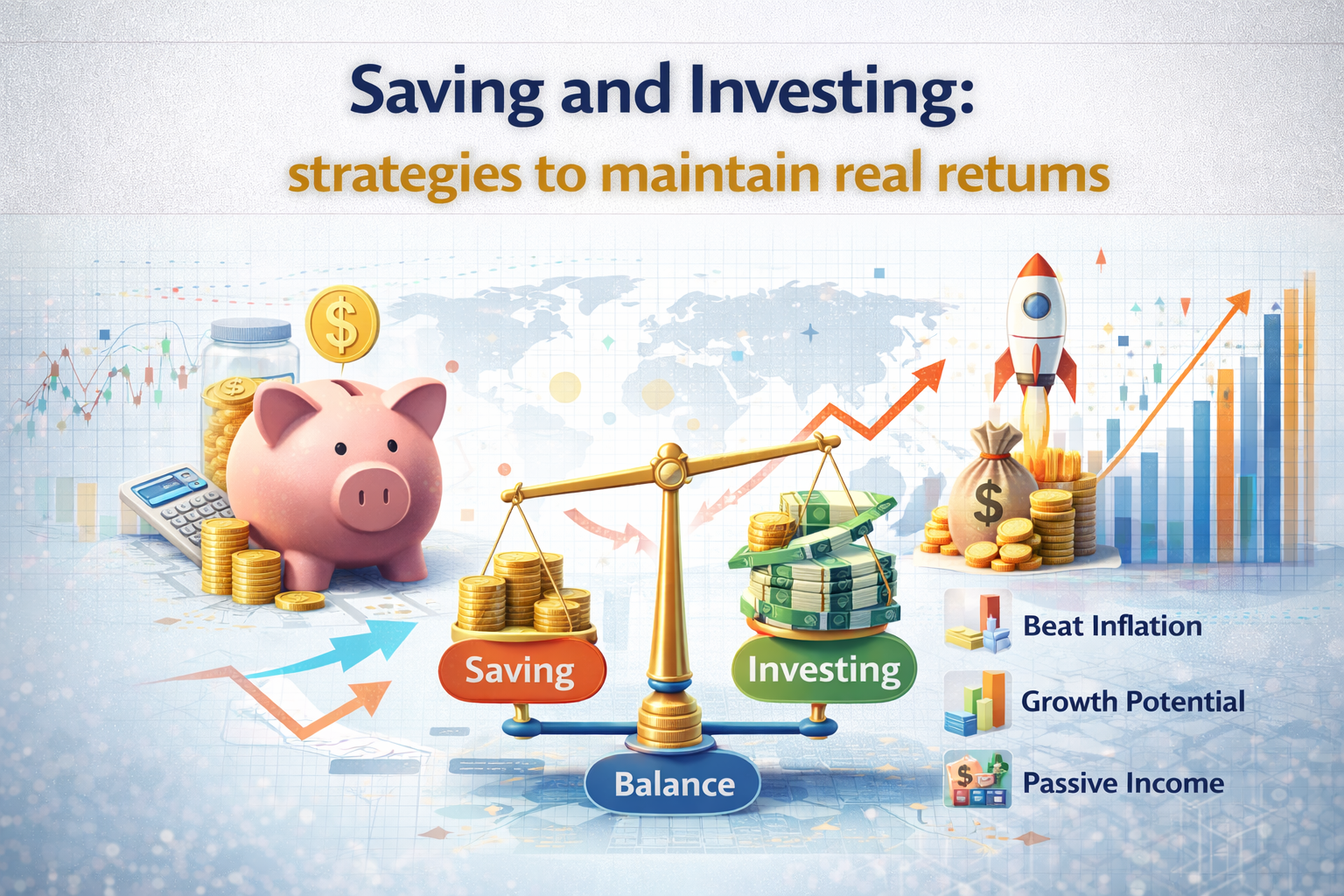
Savings serve a security function. This capital is intended to cover unforeseen events, near-term expenses, or emergencies. It must be liquid and low-risk. Investment, conversely, seeks capital growth and accepts a certain level of risk in exchange for higher potential returns.
A solid financial strategy combines both: first, build an Emergency Fund (covering 3–6 months of expenses), and once achieved, funnel the surplus into diversified investments.
Strategic Deep Dive: The Mathematics of Wealth and the “Hidden Tax” of 2026
To master real returns in the current economic climate, you must understand the Fisher Equation. Mathematically, it is expressed as:
$$(1 + r) = \frac{(1 + i)}{(1 + \pi)}$$
Where $r$ is the real interest rate, $i$ is the nominal interest rate, and $\pi$ is the inflation rate. In 2026, many “safe” products offer a nominal $i$ of 3%, but with a $\pi$ of 3.5%, your $r$ becomes negative. This is the “Hidden Tax” of inflation—it shrinks your wealth without you ever seeing a bill.
A critical strategic concept for 2026 is Asset Location. It’s not just about what you buy, but where you keep it. In a high-inflation environment, holding Real Assets (such as real estate, commodities, or equities in companies with “pricing power”) is essential. These assets tend to have a high Correlation with inflation, meaning their value often rises alongside prices, acting as a natural hedge.
Furthermore, we must address the Volatility of Inflation. In 2026, we are seeing “waves” of price increases rather than a steady line. This requires a Dynamic Rebalancing strategy. If your portfolio is too heavy in fixed income when inflation spikes, your real return collapses. Strategic investors now use Inflation-Linked Bonds (TIPS), where the principal of the bond adjusts according to the Consumer Price Index (CPI), ensuring that your “Real” principal remains intact regardless of how high prices climb.
Lastly, we must emphasize the Cost of Entry. In 2026, high management fees are the “silent killers” of real returns. If you earn a 2% real return but pay 1.5% in management and platform fees, your actual net growth is a negligible 0.5%. Moving toward Low-Cost Indexation is the most effective way to “recapture” that lost percentage. By minimizing the “Leakage” of fees and taxes, you ensure that the magic of Compound Interest works for you, not for your bank.
Diversification and the Power of Compounding
One of the keys to maintaining real returns is Asset Diversification. Investing in a single product exposes you to specific market risks. By spreading capital across stocks, bonds, real estate, and index funds, you reduce volatility and improve the stability of your results.
Compound Interest remains the most powerful force in wealth creation. By reinvesting your gains, you allow them to generate their own returns. The longer your time horizon, the greater the cumulative effect. Starting early, even with small amounts, is more effective than trying to catch up with large contributions later in life.
Adjusting to the Economic Cycle and Reducing Costs
Economic conditions change. In high-inflation periods, fixed-income instruments may lose appeal if their yields don’t keep up. Reviewing your strategy periodically—without over-trading—is essential. Furthermore, you must be vigilant about commissions and fees. High management costs can significantly erode your real gains. Choosing cost-efficient instruments like Index Funds (ETFs) ensures more of the return stays in your pocket.
Conclusion: A Vision of Stability
In a changing economic world, traditional saving is no longer enough to protect your purchasing power. You must combine security and growth through a strategy that includes liquidity for emergencies and a well-managed, diversified investment portfolio. Maintaining real returns is an attainable goal if you plan clearly, diversify correctly, and maintain a long-term vision. The key is not to chase extraordinary yields, but to build a sustainable strategy that consistently grows above inflation.